
Optical telescope
Instrument that gathers visible light to magnify distant objects.

NASA Goddard Space Flight Center from Greenbelt, MD, USA · Public domain
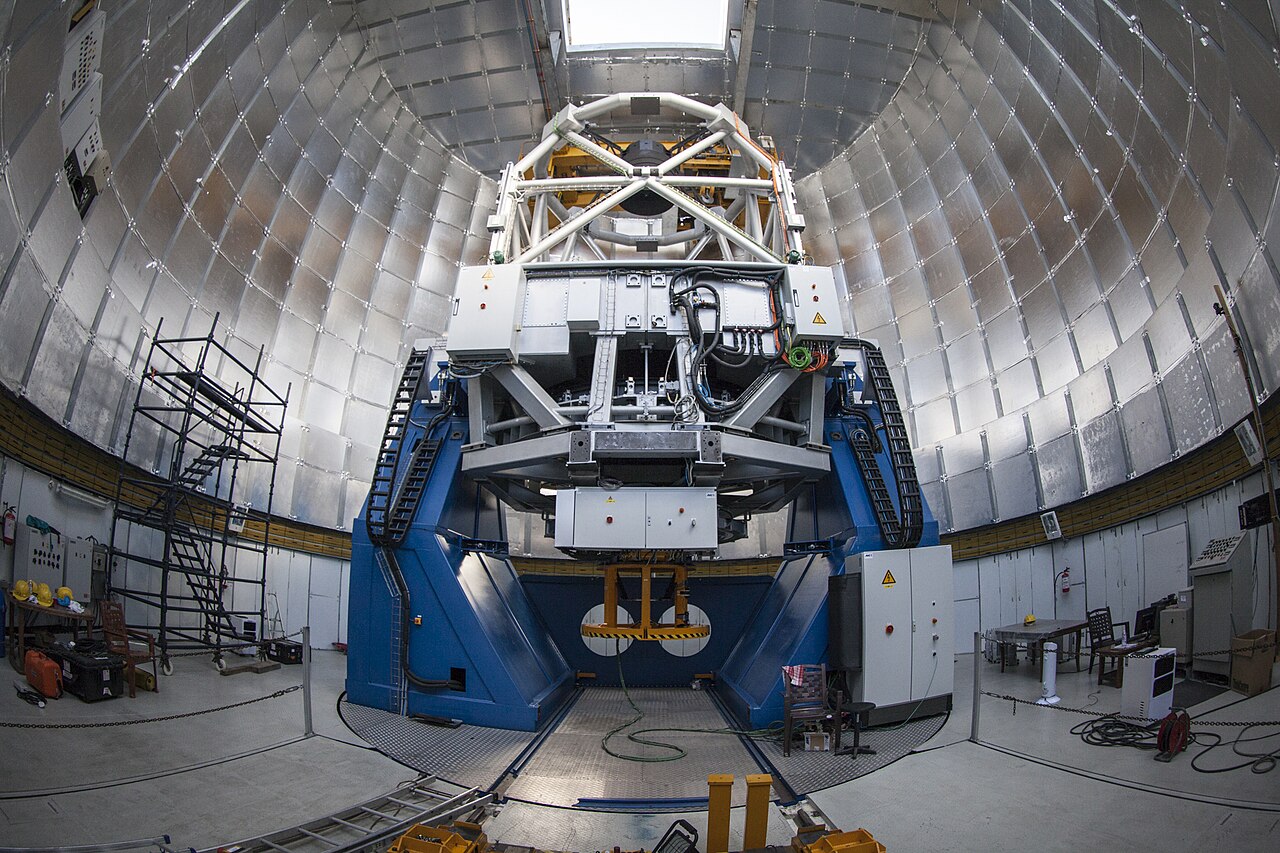
An optical telescope is an instrument that gathers and focuses light from the visible part of the electromagnetic spectrum to create a magnified image for direct visual inspection, photography, or data collection via electronic image sensors. Its ability to resolve fine details and gather light is directly related to the diameter (aperture) of its objective, making larger objectives capable of revealing finer detail and collecting more light. Optical telescopes are used in activities such as observational astronomy, ornithology, pilotage, hunting, reconnaissance, and watching performance arts and spectator sports.
- field
- Optics, Astronomy
- known_for
- Gathering and focusing visible light to create magnified images of distant objects
- types
- Refracting, Reflecting, Catadioptric
Lore & Background
The telescope is more a discovery of optical craftsmen than an invention of a scientist. The lens and properties of refracting and reflecting light had been known since antiquity, with theory developed by ancient Greek philosophers, preserved and expanded in the medieval Islamic world, and advanced by the time of the telescope's invention in early modern Europe. The most significant step was the development of lens manufacture for spectacles, first in Venice and Florence in the thirteenth century, and later in the Netherlands and Germany.
Reader's Guide
The optical telescope's significance lies in its ability to extend human vision, revealing details of celestial and terrestrial objects otherwise invisible to the naked eye. Its development spurred major advances in astronomy, from Galileo's early observations to modern space telescopes. The invention of the achromatic lens in the early 18th century corrected chromatic aberration, allowing shorter instruments with larger objectives. Reflecting telescopes, using curved mirrors, overcame chromatic aberration and led to designs like the Newtonian telescope. Catadioptric telescopes, combining lenses and mirrors, emerged in the mid-20th century for wide-field imaging. The late 20th century saw adaptive optics and space telescopes to counter atmospheric distortion, while the early 21st century brought computer-connected telescopes enabling non-professional skywatchers to observe faint objects using digital astrophotographic techniques. The telescope's legacy is its role in transforming humanity's understanding of the cosmos and enabling detailed observation of the natural world.
Did You Know?
- Galileo Galilei made his own improved designs within a year of hearing of the telescope and was the first to publish astronomical results using one.
Origins in the Lens-Making Trade
The telescope did not spring from a single scientist's laboratory. Its roots stretch back to ancient Greek philosophical work on how light refracts and reflects, knowledge that was preserved and expanded through the medieval Islamic world before reaching a notably advanced state in early modern Europe. The practical breakthrough, however, came from the world of spectacle making. Lens production for eyeglasses first took hold in thirteenth-century Venice and Florence, then later in the Netherlands and Germany, where dedicated centers of optical craftsmanship flourished. It was in this context that the first documented refracting telescope appeared in 1608 in the Netherlands, when spectacle maker Hans Lippershey filed a patent describing the device. Within weeks, Jacob Metius and a third, unidentified applicant also claimed knowledge of the same "art." The episode underscores that the telescope was less a scientific invention than a natural outgrowth of an existing craft tradition, with the theoretical groundwork laid centuries earlier by philosophers and the practical skill refined by artisans over generations.
Galileo, Kepler, and the Achromatic Revolution
Word of the Dutch invention traveled quickly, and within a year Galileo Galilei had built his own improved instruments and became the first person to publish astronomical findings obtained through a telescope. His design paired a convex objective lens with a concave eyepiece, a configuration now known as the Galilean telescope. Johannes Kepler soon proposed a modification replacing the concave eyepiece with a convex one, giving rise to what is called the Keplerian telescope. Yet both designs suffered from chromatic aberration, a color-fringing problem that plagued refractors for decades. The solution arrived in the early eighteenth century with the achromatic lens. Chester Moor Hall is credited with designing the first such lens in 1729, combining a concave crown glass element with a convex flint glass element. John Dollond later refined the design and secured the first patent. This correction allowed builders to construct much shorter instruments with significantly larger objectives, transforming the refracting telescope from a curious novelty into a serious tool for observing the heavens.
The Long Road of the Reflecting Telescope
While refractors captured early attention, the reflecting telescope followed a longer and more difficult path from theory to practice. The theoretical foundation for curved mirrors behaving analogously to lenses was likely established by Alhazen, whose work was widely disseminated through Latin translations. After the refracting telescope's invention, Galileo, Giovanni Francesco Sagredo, and others discussed building mirror-based instruments, recognizing that parabolic mirrors could reduce spherical aberration and eliminate chromatic aberration entirely. James Gregory published a notable design in 1663, now called the Gregorian telescope, but no working models were ever constructed. Isaac Newton is generally credited with building the first practical reflecting telescope, the Newtonian design, in 1668. However, the difficulty of fabrication and the poor performance of speculum metal mirrors meant reflectors did not become popular for over a century. Subsequent breakthroughs included perfected parabolic mirror fabrication in the eighteenth century, silver-coated glass mirrors in the nineteenth, long-lasting aluminum coatings in the twentieth, segmented mirrors for larger diameters, and active optics to counter gravitational deformation.
From Adaptive Optics to the Digital Skywatcher
The late twentieth century brought two major advances that addressed the blurring effect of Earth's atmosphere on astronomical observations: adaptive optics and space-based telescopes. Then, the electronics revolution reshaped who could use a telescope and how. In the 2010s, computer-connected telescopes emerged, allowing non-professional skywatchers to observe stars and satellites with relatively low-cost equipment. These instruments leverage digital astrophotographic techniques that professional astronomers had developed over prior decades. An electronic link to a smartphone, tablet, or laptop is required to make observations. The digital workflow enables multiple images to be stacked while subtracting the noise component, producing views of Messier objects and faint stars as dim as an apparent magnitude of fifteen using consumer-grade gear. Alongside these modern tools, optical telescopes continue to serve a wide range of activities beyond astronomy, including ornithology, pilotage, hunting, reconnaissance, and watching performance arts or spectator sports, with monoculars and binoculars representing the most portable end of the spectrum.
Gallery




Frequently Asked Questions
What is an optical telescope?
An optical telescope is a device that collects visible light and focuses it to produce a magnified image of a distant object. It can be used for direct viewing, photography, or feeding data to electronic image sensors.
What are the main types of optical telescopes?
There are three primary designs: refracting (using lenses), reflecting (using mirrors), and catadioptric (combining both lenses and mirrors). Each type gathers and focuses visible light through a different optical arrangement.
Why does aperture size matter for an optical telescope?
A larger objective diameter lets the instrument collect more light and resolve finer detail in the image it forms. This is why astronomers and other users often seek the widest practical aperture for their needs.
What fields and activities rely on optical telescopes?
They are used in observational astronomy, ornithology (birdwatching), pilotage, hunting, reconnaissance, and even watching live performance arts from a distance. Essentially any task requiring magnified visual inspection of far-away objects can benefit from one.
What is the core function that sets an optical telescope apart from other instruments?
Its defining role is gathering and focusing light specifically from the visible portion of the electromagnetic spectrum to create a usable magnified image. This distinguishes it from radio, infrared, or ultraviolet instruments that target other wavelength bands.
More in Science & Measurement 1-16
Spotted an error? Know more?
This is a living reference — every entry is fact-audited, and reader corrections feed straight into our audit queue. Suggest an edit · See this site's audit record