Telescope
Device for observing distant objects via electromagnetic radiation.

Pelligton · CC BY-SA 4.0
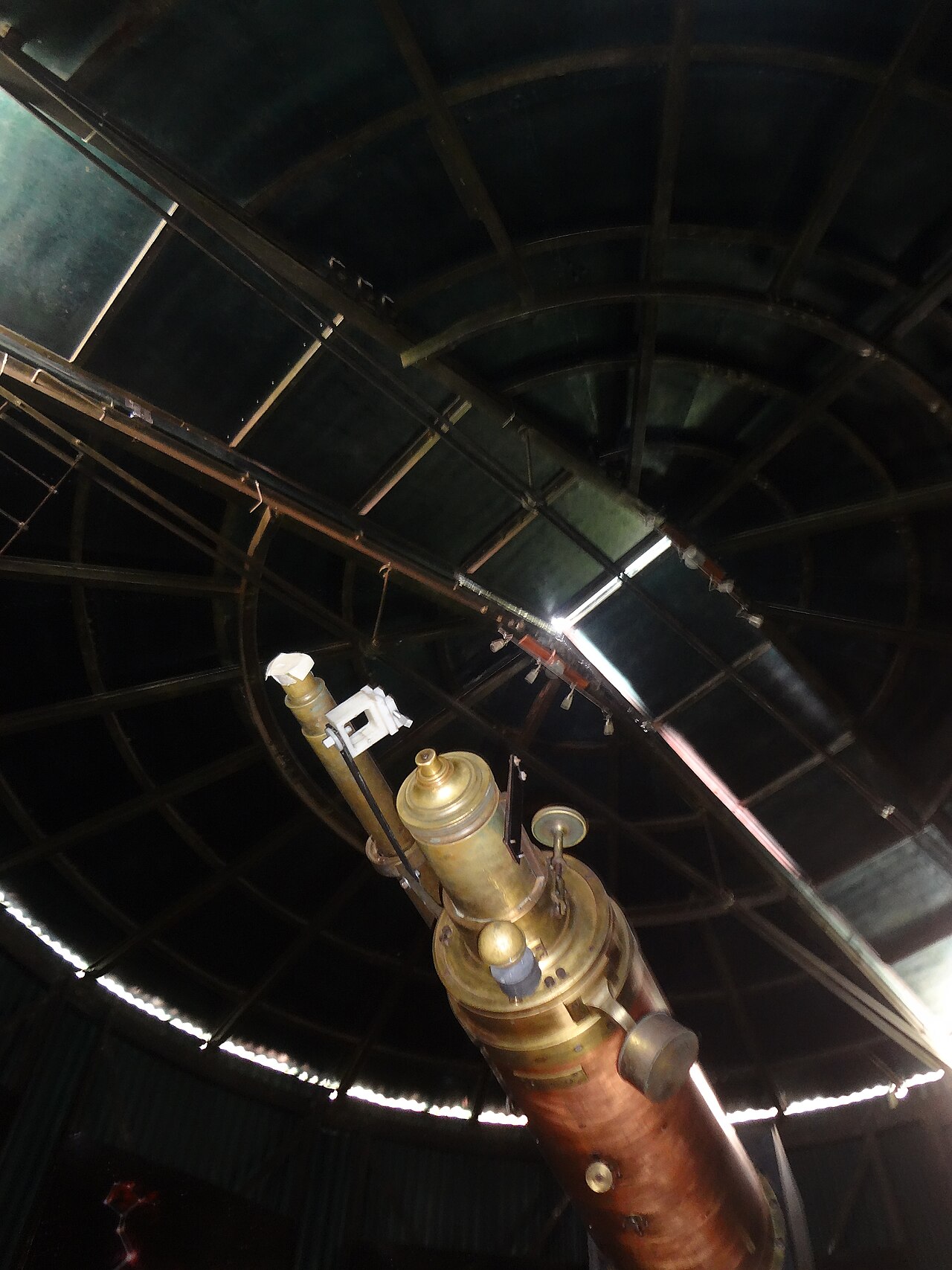
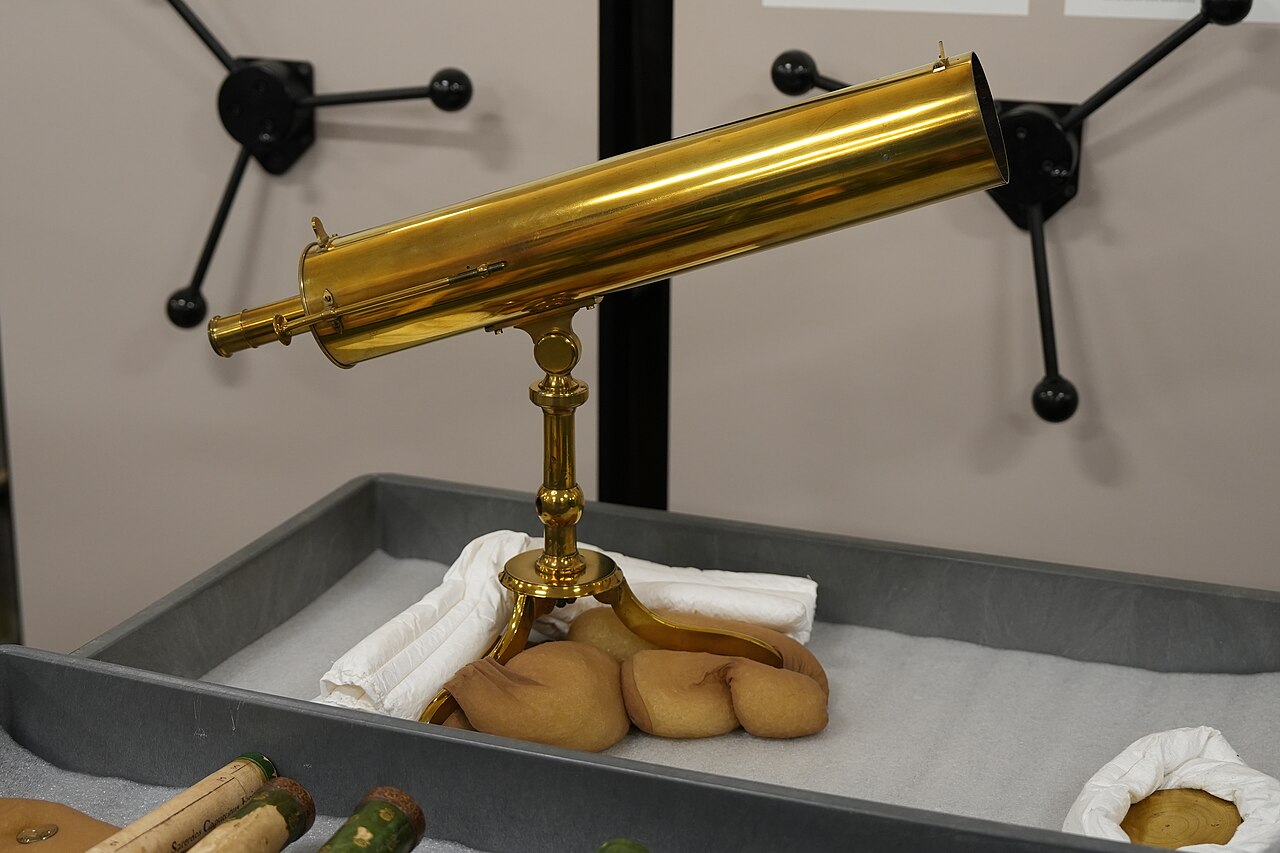
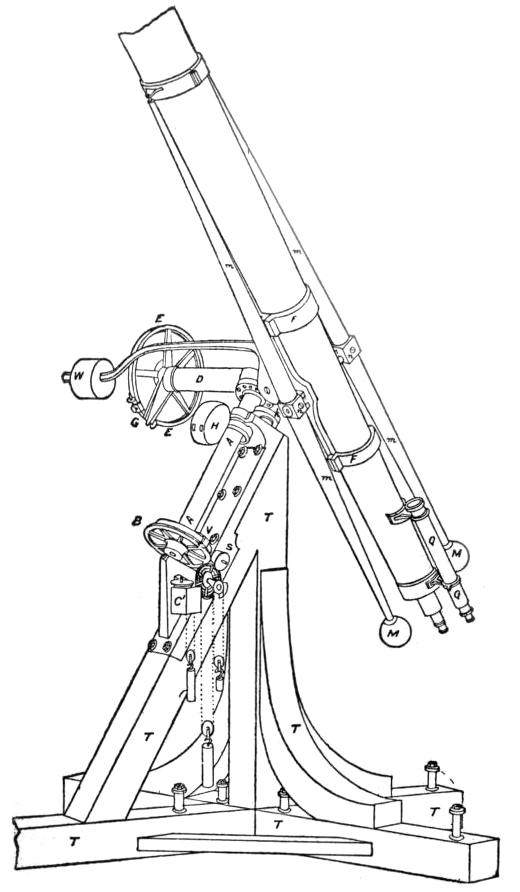
A telescope is a device used to observe distant objects by their emission, absorption, or reflection of electromagnetic radiation. Originally an optical instrument using lenses, curved mirrors, or a combination of both, the term now encompasses a wide range of instruments capable of detecting different regions of the electromagnetic spectrum. Telescopes have been fundamental to astronomy and terrestrial observation since their invention in the early 17th century.
- types
- optical, radio, infrared, X-ray, gamma-ray
- key_inventors
- Hans Lipperhey, Galileo Galilei, Isaac Newton, John Dobson
- largest_reflecting_telescopes
- objectives larger than 10 meters (33 feet)
- first_infrared_telescope
- 1960s
Reader's Guide
The telescope's significance lies in its expansion of human vision beyond the unaided eye, enabling discoveries about the cosmos. Because Earth's atmosphere is opaque for most of the electromagnetic spectrum, space telescopes are necessary for X-ray and far-infrared observations. Radio telescopes use dishes or arrays to collect radio waves, and techniques like aperture synthesis allow high-resolution imaging. Optical telescopes gather visible light and are used in many instruments beyond astronomy, including theodolites and binoculars.
Did You Know?
- The maximum physical size limit for refracting telescopes is about 1 meter (39 inches).
An Engineering Marvel Built for the Cold
The James Webb Space Telescope represents a remarkable feat of optical engineering, centered on a primary mirror composed of eighteen individually shaped hexagonal segments crafted from beryllium and coated in a thin layer of gold to maximize infrared reflectivity, with a protective glass overlay added for durability. Together, these segments form a 6.5-meter aperture whose polished collecting area spans roughly 25 square meters—more than six times the light-gathering surface of Hubble's 2.4-meter mirror—yet the overall mass of Webb is only about half that of its predecessor. A critical constraint shapes every design choice: the telescope must operate below 50 kelvin, a temperature so frigid that any thermal radiation emitted by the hardware itself would drown the faint infrared signals it is meant to collect. To achieve this, a five-layer sunshield stands between the optics and the combined heat of the Sun, Earth, and Moon, keeping the mirror assembly in a state of deep cold. Even the secondary mirror's support struts, which obscure roughly 0.9 square meters of the primary surface, were engineered to minimize thermal interference while holding the optical train in precise alignment.
Seeing Deeper into the Cosmic Past
By operating in the infrared spectrum from 0.6 to 28.5 micrometers, Webb unlocks a window into the universe that visible-light telescopes simply cannot access. Its sensitivity allows it to detect objects roughly one hundred times fainter than Hubble, pushing observations back to redshifts near twenty—approximately 180 million years after the Big Bang—close to the epoch when the very first stars are believed to have ignited. Hubble, by contrast, reaches only to about redshift eleven. The infrared choice is not arbitrary: light from the most distant galaxies has been stretched by cosmic expansion into infrared wavelengths, dust clouds that obscure young star-forming regions are far more transparent to longer wavelengths, and cool objects like debris disks and exoplanets radiate most strongly in the infrared. Webb's instruments can also characterize the atmospheres of potentially habitable worlds around other stars, detect chemical signatures such as water, carbon dioxide, and methane that would be impossible to isolate from Earth's own atmosphere, and respond to transient events like supernovae or gamma-ray bursts within forty-eight hours of a decision to point the telescope.
A Decade of Redesigns and International Partnership
What is now the James Webb Space Telescope began in 1996 under the working name Next Generation Space Telescope, with two concept studies commissioned in 1999 that envisioned a 2007 launch on a one-billion-dollar budget. Reality proved far more demanding. The program endured enormous cost overruns and schedule delays, culminating in a significant redesign in 2005. Construction was not completed until 2016, followed by years of exhaustive testing, and the final price tag reached ten billion dollars. The project was a genuinely multinational endeavor: NASA led design and development with the European Space Agency and the Canadian Space Agency as central partners. NASA's Goddard Space Flight Center in Maryland managed the telescope's development, while the Space Telescope Science Institute, housed on the Homewood campus of Johns Hopkins University in Baltimore, handles its day-to-day operations. Northrop Grumman served as the primary contractor. The observatory carries the name of James E. Webb, who administered NASA from 1961 to 1968 through the Mercury, Gemini, and Apollo eras.
Launch, Orbit, and First Light
Webb left Earth on 25 December 2021, riding an Ariane 5 rocket from the Kourou spaceport in French Guiana. Over the following weeks it performed a series of course corrections until, in January 2022, it settled into a halo orbit around the Sun–Earth L2 Lagrange point, a gravitationally stable region roughly 1.5 million kilometers (930,000 miles) beyond Earth's own orbit. This location keeps the Sun, Earth, and Moon in a fixed angular relationship, allowing the five-layer sunshield to maintain its orientation permanently. Although Webb's mirror is 2.7 times the diameter of Hubble's, the two telescopes produce images of broadly comparable angular resolution because Webb observes at longer infrared wavelengths, which inherently demand a larger collecting surface to resolve fine detail. After a period of commissioning and calibration, the telescope's first full-color image was released to the public on 11 July 2022, marking the moment when a new era of infrared astronomy officially began.
Gallery
Frequently Asked Questions
What is a telescope?
A telescope is an instrument that lets you see faraway objects by collecting the light or other electromagnetic signals they emit, absorb, or bounce back. While the earliest versions relied on glass lenses and curved mirrors, modern telescopes can detect radiation across the entire spectrum.
Who invented the telescope?
The device is generally credited to Hans Lipperhey in the early 1600s, though Galileo Galilei was the first to point one at the sky for serious astronomy. Isaac Newton later introduced the reflecting design, and John Dobson made them far more accessible to the public.
What types of telescopes are there?
Beyond the familiar optical kind, telescopes come in radio, infrared, X-ray, and gamma-ray variants, each tuned to a different slice of the electromagnetic spectrum. This means astronomers can study the same object in multiple 'colors' of radiation.
How large do the biggest reflecting telescopes get?
The largest modern reflecting telescopes feature primary mirrors exceeding 10 meters, or roughly 33 feet, in diameter. These enormous optics gather enough faint light to probe objects at the edge of the observable universe.
When was the first infrared telescope built?
The first dedicated infrared telescope appeared in the 1960s, expanding what astronomers could observe beyond visible light. This opened up a new window for studying cool dust clouds, forming stars, and other objects that glow primarily in infrared wavelengths.
More in Science & Measurement 1-16
Spotted an error? Know more?
This is a living reference — every entry is fact-audited, and reader corrections feed straight into our audit queue. Suggest an edit · See this site's audit record